India Begins Local Production of CSR 338 Sniper Rifles for CRPF
In a significant development for India’s defence manufacturing ecosystem, the joint venture between UAE-based Caracal International and Indian firm Icomm Tele Ltd (a subsidiary of Megha Engineering & Infrastructures Ltd, or MEIL) has secured a major contract to supply 200 advanced sniper rifles to the Central Reserve Police Force (CRPF). Under this agreement, 200 units of the high-performance CSR 338 sniper rifle will be manufactured locally — marking another step in India’s push toward indigenization of defence procurement under the “Make in India” initiative.
Building local capacity: the Icomm-Caracal Small Arms Complex
The rifles are slated to be produced at the newly inaugurated Icomm–Caracal Small Arms Complex in Hyderabad. The facility officially began operations in April 2025, and has been designed as a modern manufacturing hub to locally produce a range of small arms for India’s security forces, with room for future expansion — including global export potential.
Setting up such a facility reflects a shift in India’s defence procurement strategy: rather than simply importing advanced weapons, the country is now laying down infrastructure to manufacture them domestically, thus building sovereign defence manufacturing capabilities.
The deal: 200 rifles to CRPF, delivery by end-2025
Under the contract, 200 units of CSR 338 rifles will be delivered to the CRPF. The first batch — rifles “made in Hyderabad” — is expected to be handed over in the fourth quarter of 2025.
This supply is not merely equipment procurement. For its promoters, the deal embodies a broader ambition: to transfer world-class small-arms manufacturing technology to India, create skilled jobs, and contribute toward a robust domestic defence-industrial base, rather than relying on foreign imports.
What is the CSR 338 — and why it matters
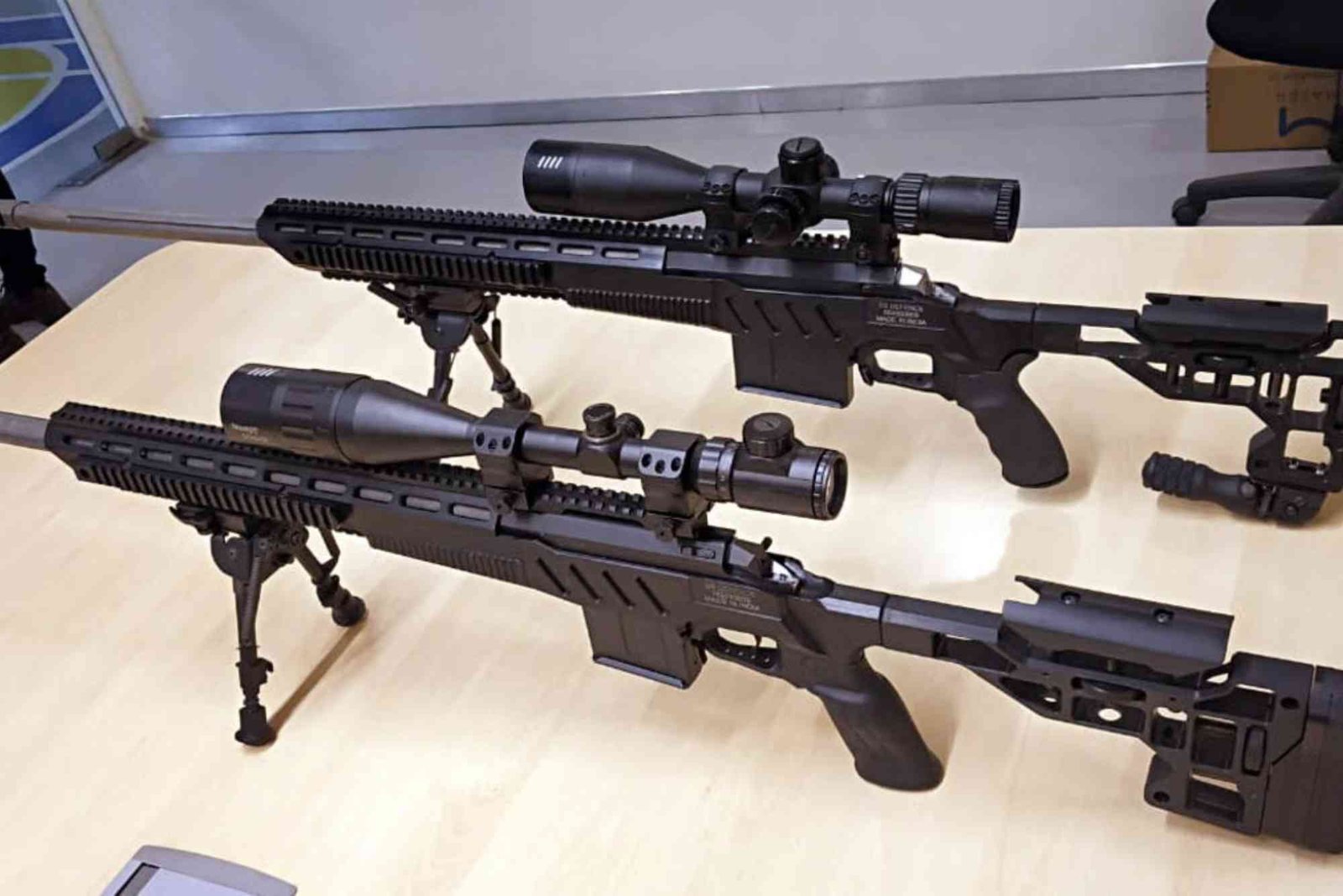
The CSR 338 sniper rifle is a bolt-action precision weapon chambered in .338 Lapua Magnum. Its specifications reflect its role as a long-range, high-accuracy sniper rifle designed for modern combat, counter-insurgency, or internal security operations. Key technical features include:
- A 27-inch barrel.
- A 10-round magazine.
- Ambidextrous safety and magazine release, making it user-friendly for both left- and right-handed shooters.
- A two-stage adjustable precision trigger — enabling fine control and accuracy.
- Foldable, telescopic stock with multiple adjustment positions — improves ergonomics and portability on operations.
For CRPF — a paramilitary force with a major role in internal security, counter-insurgency, anti-terror operations, and law & order enforcement — having access to such sniper platforms significantly enhances their tactical abilities. In unstable zones or high-risk operations where conventional small arms might not suffice, sniper rifles like CSR 338 offer precision capability at long ranges, contributing to deterrence and operational effectiveness.
Thus, this deal is more than just a weapons purchase — it’s an upgrade in capability for security forces engaged in demanding, often high-stakes internal security tasks.
Strategic importance: a milestone for “Make in India” and India–UAE Defence Cooperation
For India, the significance of this contract lies not only in acquiring advanced hardware, but in strengthening the domestic defence manufacturing ecosystem. Under the joint-venture, technology transfer from Caracal (which is part of UAE’s EDGE Group) to Icomm Tele Ltd ensures that the rifles will be produced under global-standard manufacturing and quality controls — but within India.
This is the first time such advanced sniper systems are being locally produced for India’s paramilitary forces under an Indo-UAE collaboration, marking a significant milestone in bilateral defence cooperation and signalling growing trust and depth in India–UAE strategic ties.
Moreover, the establishment of the Icomm–Caracal Small Arms Complex in Hyderabad contributes to decentralizing defence manufacturing away from traditional defence-heavy zones — bringing capabilities to new geographies, creating employment and skill development opportunities, and strengthening India’s overall defence industrial base.
For Caracal and EDGE, the venture represents an expansion of their global footprint through a locally embedded manufacturing base tailored for Indian requirements — both for domestic demand and potential future export orders.
Beyond 200 rifles — potential for scaling and future expansions
While the immediate order is for 200 rifles, the Icomm–Caracal facility is equipped to produce a wider portfolio of small arms to meet not only CRPF’s long-term needs, but also for other Indian security forces, and even for exports. According to company sources, the manufacturing complex could handle a broad range of weapons — from sniper rifles to assault rifles, sub-machine guns, and more — depending on future contracts.
The technology transfer model central to this venture also means that over time, Indian defense manufacturing could reduce dependency on imports — enabling self-reliance, faster procurement cycles, lower foreign exchange outflows, and deeper local expertise. The potential for lifecycle support, maintenance, and eventual indigenous upgrades further strengthens the long-term value proposition of this contract.
What the leadership says: company views on the deal
Company executives have underscored that this contract represents more than just a business win — it validates their long-term strategy of building sovereign defence capability in India. The leadership of Icomm Tele Ltd describes it as a “proud milestone,” reflecting confidence in their manufacturing infrastructure, workforce, and commitment to quality.
From Caracal’s side, this marks a historic transfer of small-arms technology from UAE to India — demonstrating trust, partnership, and a long-term vision of cooperation beyond a one-time sale. It demonstrates their commitment to contributing toward India’s security requirements and to supporting the country’s growing defence ambitions.
In their statements, the firms highlighted that the contract represents more than supply: it is about technology transfer, quality manufacturing, job creation, and strengthening India’s defence industrial ecosystem, especially in Hyderabad.
Wider context: shifting trends in Indian defence procurement
This contract comes at a time when India is increasingly looking to reduce defence imports and strengthen its domestic manufacturing base. Over the past decade, there has been strategic emphasis on “Atmanirbhar Bharat” (self-reliant India), and this arms-manufacturing deal is a concrete example of how cooperation with foreign defence firms can be leveraged to build domestic capacity — combining global-level technology with local execution. The collaboration between Icomm Tele and Caracal demonstrates a functional model of such cooperation.
Additionally, having a domestic facility capable of producing advanced weapons and ammunition in India improves responsiveness to security requirements. For forces such as CRPF, which operate across a variety of terrains and face evolving security challenges, local manufacturing ensures better supply chain control, maintenance support, and scalability — a considerable advantage over imported, plug-and-play arms.
Moreover, a successful deployment of CSR 338 rifles to CRPF could serve as a proof-of-concept, encouraging further investments into domestic defence manufacturing — potentially paving the way for more complex systems, upgrades, customization, or even export deals from India. The facility’s design and capacity seem to anticipate such scaling.
Implications for CRPF and internal security operations
For CRPF — India’s largest paramilitary force tasked with internal security, anti-terror, counter-insurgency, and law & order duties across various challenging terrains — induction of 200 CSR 338 sniper rifles represents a significant boost in operational capability. Precision sniper rifles bring value not only in counter-insurgency or anti-terror operations but also in high-risk law-and-order situations, hostage rescues, and special missions where precision and minimum collateral risk are crucial.
The domestically manufactured rifles also facilitate easier maintenance and lifecycle support, thanks to local production — this enhances long-term reliability, reduces dependency on foreign supply chains, and ensures that CRPF can keep its sniper capability mission-ready.
From a strategic viewpoint, such capability upgrades reflect India’s evolving internal security environment and the need for sophisticated weapons and systems, even for paramilitary outfits, which historically may have relied on conventional small arms. The move signals a recalibration: paramilitary forces are being equipped with modern, precise, and powerful weaponry, enabling them to operate more effectively across varied security challenges.
A milestone — but what lies ahead?
While the contract for 200 rifles is a milestone, its success will be measured in the coming months, when the first batch gets delivered, deployed, and operationalized by CRPF. If the weapons perform reliably, it could open doors for additional orders, expansion of the manufacturing facility’s capacity, and perhaps diversification into more categories of small arms or ammunition.
The Icomm–Caracal Small Arms Complex, with its current infrastructure, seems well-positioned for such scaling — having been built not just as a small-batch manufacturing setup, but as a hub with export and growth ambitions. This could make Hyderabad a notable node in India’s defence manufacturing network, especially if more contracts — domestic or international — follow.
Finally, the success of this venture may influence defence procurement policy more broadly: encouraging similar collaborations with foreign-origin firms under Indian manufacturing umbrellas, combining global technical standards with local execution. This could bode well for India’s ambitions of self-reliance, defence exports, and strategic partnerships globally.
In sum: the Icomm–Caracal contract to supply 200 CSR 338 sniper rifles to CRPF represents more than a weapons purchase — it is a statement. It underscores India’s intent to build sovereign defence manufacturing capabilities, to integrate global expertise via collaborations, and to equip its security forces with modern, precision weapons — while ensuring local production, employment, skills, and long-term sustainability. The success of this contract could mark the beginning of a new chapter in India’s pursuit of defence self-reliance, strategic partnerships, and enhanced internal security preparedness.
Looking for premium quality wood products and creative solutions for your home or office? Explore a wide range of options and innovative designs at Woodraze. From custom furniture to décor, Woodraze is your trusted destination for craftsmanship and style. Visit our home page to discover more.